Loading Howl Media Labs
Preparing the page and animations...
Loading Howl Media Labs
Preparing the page and animations...

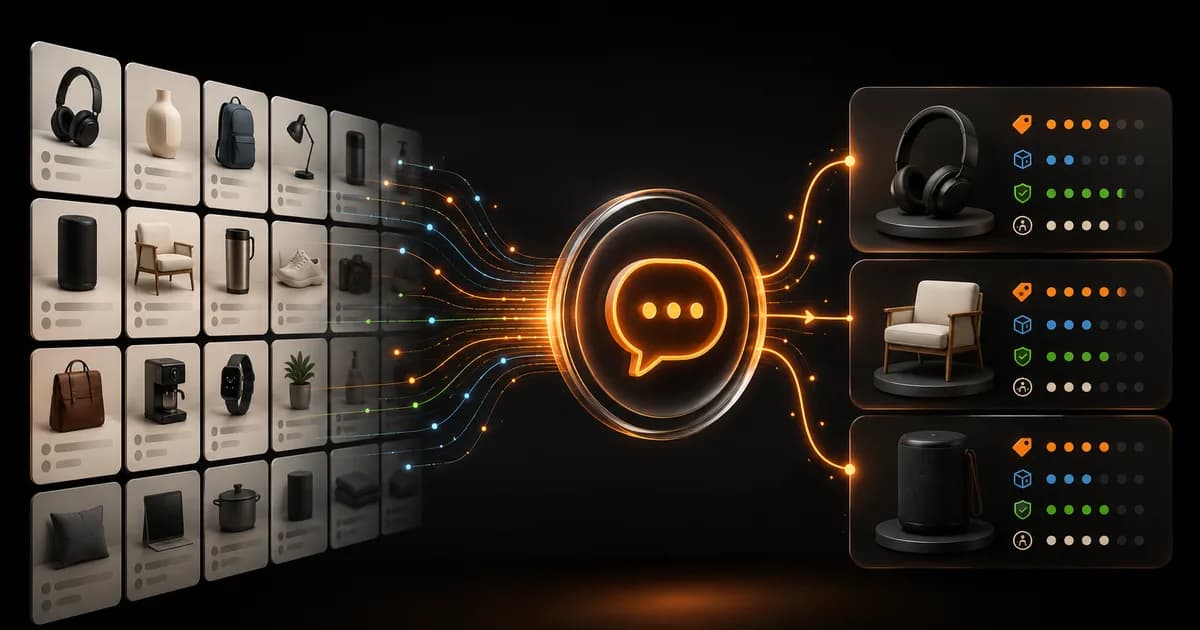
Merchant Center AI Performance Insights is now available in India for eligible English-language shopping queries. Use it to diagnose organic visibility across AI Mode and AI Overviews by category, shopping stage, terms, intents and attributes. Treat share of voice as a discovery signal—not traffic, revenue or incrementality—and validate every optimisation against feed quality and commercial outcomes.
Google confirmed general availability for India on 16 September 2026. The report gives merchants a much-needed view into how products appear during conversational shopping journeys, but the new metrics can easily be overread. A higher AI share of voice does not automatically mean more qualified visits, profitable orders or incremental demand.
Google's AI Performance Insights documentation describes a Merchant Center report for conversational shopping queries on AI Mode and AI Overviews. It is available for English-language queries in India, Australia, Canada, New Zealand and the United States.
In Merchant Center, navigate to Analytics → Products → AI performance. The report currently provides:
The current traffic filter is limited to organic AI traffic, such as free listings. Paid Ads traffic is not included. This boundary matters because a Merchant Center visibility change should not be presented as a Google Ads result.
+25% GSC Impressions Week-on-Week
See how a luxury decor brand grew organic impressions 25% week-on-weekRead it →
Google first previewed the report for India earlier in 2026. Its 16 September commerce update changed the status from a future rollout to current availability across India and four other markets.
The release sits beside product-feed and agentic-commerce updates, but not every feature has the same geography. AI Performance Insights is available in India; the Business Agent for YouTube ads beta is US-only; and new Universal Commerce Protocol checkout capabilities are initially rolling out in other markets. Record the availability of each feature separately rather than treating the announcement as one global launch.
Google's India Marketing Live summary also positions AI Performance Insights as the visibility layer for AI Mode, AI Overviews and Gemini-era shopping. The current Help Center page, however, defines the report's live scope as AI Mode and AI Overviews. Use the product documentation visible in the account as the operational source of truth.
Google calculates your share using your AI impressions divided by the combined AI impressions for your brand and the Merchant Center competitor set on related queries.
That makes it a relative visibility metric. It can move because:
Google says merchants cannot choose the comparison brands. It also notes that your share and the competitor average can rise together when the competitor data changes. A 100% share can mean insufficient competitor data, not category dominance.
Report share of voice with at least three companion measures:
| Metric | What it tells you | What it does not prove | | --- | --- | --- | | AI share of voice | Relative organic visibility for the selected scope | Clicks, sales or incrementality | | Frequency | How common a term, intent or attribute is in the report | Demand available specifically to your brand | | Products showing | Breadth of eligible products appearing | Product quality or conversion readiness | | Organic sessions | Visits measured by your analytics implementation | All AI impressions or assisted influence | | Net orders and contribution | Commercial outcomes under your finance rules | Outcomes caused by AI visibility alone |
The AEO glossary and HML's AI-search measurement guide explain why visibility, citations, referrals and conversions require separate measurement layers.
Google requires a single product-category view; there is no all-category AI Performance report. Select India, one category and a stable time range. Save the exact filters with every export or screenshot so the next review compares like with like.
Compare discovery, evaluation and ready-to-buy share. A brand may appear in broad inspiration queries but disappear when shoppers ask about specifications, alternatives, compatibility or reviews. That gap suggests a product-information problem, not necessarily a media problem.
Prioritise terms where frequency is high, share is weak and few relevant products show. Then verify that the term describes a real product fact or use case. Google's own guidance recommends incorporating relevant terms into titles and descriptions, but relevance must come before coverage.
Attributes such as material, size, compatibility, ingredients or technical specifications help systems answer comparison questions. Google's product detail documentation supports clean section, attribute and value pairs for product-specific information. It explicitly advises against listing keywords in place of genuine specifications.
Use the AI report as a diagnostic queue, not an instruction to copy every phrase into every title.
Google's product data specification warns that missing identifiers, variant attributes, images or conflicting website data can restrict eligibility. Its structured-data mapping guide recommends matching schema.org properties with Merchant Center values, especially price, currency, availability and condition.
HML's Shopify agentic-storefront guide covers the wider catalogue architecture. Use the AEO Readiness Checker to find answer and entity gaps on the landing page after feed defects are addressed.
Consider a fictional Indian footwear brand reviewing one category for two mature 28-day windows. The values are synthetic and demonstrate the reporting logic, not a market benchmark.
| Measure | Baseline | After remediation | Interpretation | | --- | ---: | ---: | --- | | AI share of voice | 8% | 12% | Relative visibility improved within Google's comparison set | | High-frequency attributes complete | 54% | 86% | More relevant product facts were supplied | | Products showing for top terms | 14 | 29 | Eligible catalogue coverage widened | | Tagged organic AI sessions | 180 | 245 | Observed visits increased, subject to attribution limits | | Net orders from tagged sessions | 9 | 13 | Commercial outcome improved, but sample is small | | Incremental orders | Not tested | Not tested | Causality remains unknown |
Method: keep the country, product category and reporting window length constant; archive the selected competitor and query views; log every feed and landing-page change; exclude out-of-stock products from the remediation denominator; preserve transaction IDs through analytics and finance; and wait for reporting lag before comparing mature windows.
The correct conclusion is that visibility, data completeness and observed visits improved together. It is not defensible to say that the four additional net orders were caused by the feed changes without a credible counterfactual.
Create four reporting rows:
If AI visibility improves but sessions do not, inspect whether users can click through from the relevant experience and whether analytics preserves the source. If sessions rise but conversion does not, inspect price, availability, delivery, trust and landing-page continuity. If platform and finance totals disagree, resolve transaction IDs and order-status rules before declaring growth.
The attribution glossary is useful when teams are tempted to assign every assisted outcome to a single surface. HML's Shopify analytics case study provides implementation context for making product and transaction data auditable; its results are not evidence for the synthetic example above.
Build a one-page AI visibility register for each priority category:
Rank fixes by frequency × commercial relevance × affected products, then subtract implementation risk. A missing material value across 200 best-selling products usually deserves attention before a low-frequency phrase affecting two products.
If the audit reveals conflicts across Merchant Center, Shopify, structured data and analytics, request a product-data and AI-visibility audit or review HML's website development service. The intended deliverable is a field-level remediation backlog tied to measurable shopping stages, not a generic promise to “optimise for AI.”
Reviewed by rajkumar-tahalani on 19 September 2026. Access dates are shown for time-sensitive references.

AI, Agents & Automation
ChatGPT Ads and Sponsored Agents: An India Readiness Guide for D2C Brands
AI Automation
ChatGPT Shopping Product Visibility Audit for Indian D2C Brands
Free Tool
Conversion Rate Calculator
Measure your conversion rate and revenue upside.
Case Study
4.5x Total ROI
How a Premium Bespoke Tailoring Brand Achieved 4.5x ROI Across Digital Channels
We help Indian D2C brands grow with performance marketing, AI automation, and AEO-ready content. Book a free strategy call and we'll show you where the biggest wins are.
Or See how a luxury decor brand grew organic impressions 25% week-on-week.